The COMMAND Framework: How to Build AI Organizations You Can Trust
DEPLOY helps you build one useful AI agent. COMMAND helps you design the operating model around multiple agents, humans, workflows, knowledge, governance, and oversight.
In the last post, I wrote about DEPLOY.
DEPLOY is the framework for building one useful AI agent.
Not a better prompt.
Not a toy workflow.
An agent with a mission, identity, resources, guardrails, connections, and earned autonomy.
That matters because most people are still trying to get AI to do serious work with unserious structure.
But once you can deploy one agent well, the next problem shows up fast.
How do multiple agents work together?
How do humans stay in the loop without babysitting everything?
Where does shared knowledge live?
How do handoffs happen?
What can run autonomously?
What needs approval?
How does the leader see what is happening without getting dragged back into every task?
That is not a prompt problem.
That is an operating model problem.
DEPLOY builds the agent.
COMMAND builds the system around it.
The gap between pilots and operating systems
AI agent pilots are easy.
That does not mean they are worthless. Pilots prove possibility. They help you test a workflow, validate a use case, and build confidence.
But a pilot can survive because one excited person is standing next to it, fixing the rough edges, checking the output, and nudging the process along.
That is not transformation.
That is a demo with adult supervision.
The real test is whether the system still works when it has to operate as part of the business.
Can it run on a schedule?
Can it receive the right inputs?
Can it hand work to another agent or person?
Can it access trusted knowledge?
Can it stop when the stakes are too high?
Can it tell you what happened?
Can it improve over time?
That is where COMMAND comes in.
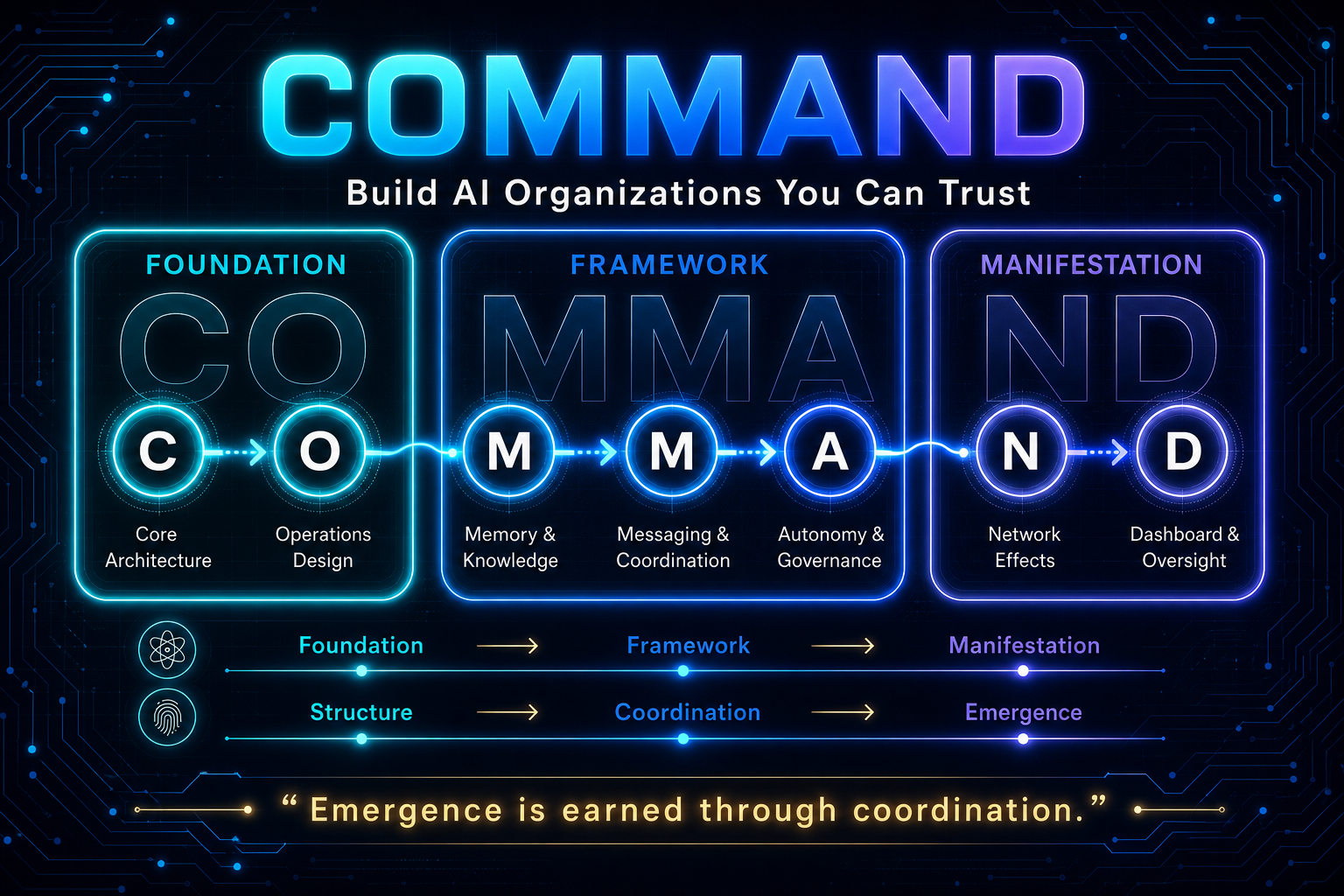
COMMAND is the framework for designing AI organizations you can trust.
Not just agents.
Organizations.
Because the real leverage starts when agents, humans, workflows, memory, permissions, review loops, and dashboards work together as one coordinated system.
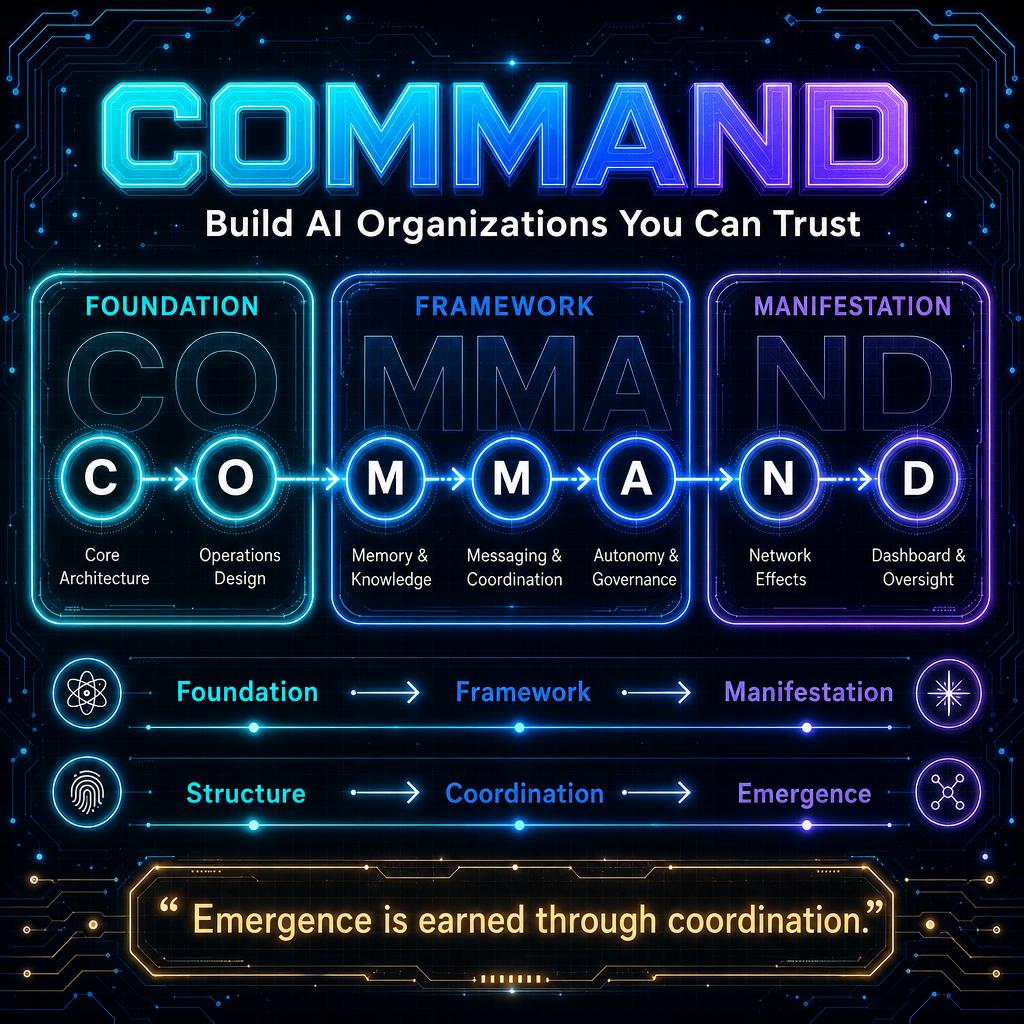
The Commander Triad
COMMAND is built on three layers:
- Structure
- Coordination
- Emergence
Structure is the foundation. It answers, "What is this AI organization?"
Coordination is the framework. It answers, "How does the organization operate together?"
Emergence is the manifestation. It answers, "What becomes possible because the parts are connected?"
That last word matters.
Emergence is not something you force.
Emergence is earned through coordination.
When the roles are clear, the rhythms are reliable, the knowledge is trusted, the handoffs are explicit, the governance is sane, and the oversight is visible, the system can produce value no single agent could create alone.
That is the Commander move.
Not chasing every tool.
Designing the operating system.
C — Core Architecture
Commander-level AI work begins when you stop asking, "What can AI do for me?"
That question is too small.
The better question is:
What roles should exist in this AI organization?
Core Architecture is your AI org chart.
It defines the functions, ownership, boundaries, and escalation paths before you start wiring up automations.
A founder might start with three simple roles:
- A research agent that gathers and summarizes useful intelligence
- A content agent that turns approved source material into drafts
- An operations agent that checks recurring workflows and flags exceptions
Those roles should not all behave the same way.
They should not all have the same tools.
They should not all have the same authority.
Architecture creates clarity before speed.
Without it, every agent becomes a vague generalist, and vague generalists are where trust goes to die.
Core Architecture asks:
- What functions need ownership?
- Which agents should be specialists?
- Where should humans stay in the loop?
- Which responsibilities should never be ambiguous?
The output is a clear AI org map.
Named roles.
Clear accountabilities.
Boundaries.
Escalation paths.
This is the structure of the system.
O — Operations Design
An AI organization needs rhythm.
Not vibes.
Rhythm.
Operations Design defines when work happens, what triggers it, how handoffs occur, and what gets reviewed.
Some work should happen daily.
Some work should happen weekly.
Some work should happen only when an event occurs.
Some work should never happen unless a human approves it.
This is where the system moves from "I can ask AI for help" to "the business has intelligent operating cadence."
For example:
- Every weekday morning, an agent prepares a daily pulse brief
- Every Friday, a content agent reviews the week's source material and drafts next week's posts
- When a lead enters the pipeline, a research agent prepares a context card
- When a workflow fails twice, an operations agent escalates
- When a recommendation touches money, reputation, legal claims, or external communication, a human approves it
That is not over-engineering.
That is leadership.
Operations Design asks:
- What should happen daily, weekly, monthly, and on demand?
- What triggers each agent?
- What gets batched?
- What needs exception handling?
- What does the human review cadence look like?
A business does not become AI-powered because it has access to models.
It becomes AI-powered when the right work happens at the right time with the right level of human judgment.
M — Memory & Knowledge
AI without memory is a talented stranger with amnesia.
It might impress you in a single conversation, but it cannot reliably carry institutional responsibility.
Memory & Knowledge defines what the AI organization knows and where truth lives.
There are three layers:
- Working memory: recent context, daily notes, current tasks, temporary state
- Institutional knowledge: durable truth, brand voice, policies, strategy, product facts, examples
- Shared context: resources multiple agents need to coordinate around the same reality
This matters because multi-agent systems fail quickly when every agent invents its own version of the truth.
The content agent should not make up the offer.
The sales agent should not guess the positioning.
The operations agent should not rely on stale instructions.
The research agent should not treat unverified notes as strategy.
Memory gives the organization continuity.
Knowledge gives it judgment.
The Commander question is simple:
If I disappeared for a month, what would a smart person need to read to operate this business responsibly?
That is your institutional knowledge base.
Build it once.
Maintain it intentionally.
Let agents work from it instead of improvising around missing context.
M — Messaging & Coordination
Most handoff problems are not technical problems.
They are clarity problems.
Messaging & Coordination defines how work moves between agents, humans, and systems.
In a human company, coordination happens through meetings, Slack, documents, project management systems, SOPs, and hallway conversations.
In an AI organization, you have to be more explicit.
The system needs to know:
- Which agents talk to each other
- What information gets passed
- What format the handoff requires
- Where shared state lives
- When a blocker gets escalated
- Who owns the next step
There are four useful coordination patterns:
- Direct messaging: one agent hands a result to another
- Shared spaces: agents work from common folders, queues, dashboards, or databases
- Contracts: structured inputs and outputs that make handoffs reliable
- Escalation channels: clear places where exceptions surface for human review
This is where a group of agents starts becoming an organization.
Not because they are smarter individually.
Because their work moves cleanly through the system.
A — Autonomy & Governance
Autonomy without governance creates risk.
Governance without autonomy creates babysitting.
COMMAND is not about giving agents unlimited control.
It is about defining where trust has been earned and where human judgment is still required.
I think about autonomy in four levels:
- Full supervision: the agent drafts, a human decides everything
- Approved autonomy: the agent can act after review
- Strategic autonomy: the agent can act within defined lanes and escalate exceptions
- Full autonomy: the agent operates independently in a narrow, proven domain
Most businesses should start lower than they want to.
That is not fear.
That is how trust compounds.
The rule of thumb is:
Internal work can earn freedom faster. External action requires approval longer.
An agent summarizing internal notes is one risk level.
An agent emailing a client, moving money, making legal claims, publishing content, or changing production systems is another.
Governance defines:
- Permissions
- Boundaries
- Approval gates
- Escalation rules
- Error handling
- Audit trails
- Review dates for expanding autonomy
The goal is not to slow everything down.
The goal is to make speed trustworthy.
N — Network Effects
The value of an AI organization is not the sum of its agents.
The value appears when one agent's work makes another agent smarter, faster, or more capable.
That is the network effect.
A research agent finds a market signal.
A strategy agent turns it into a recommendation.
A content agent turns the recommendation into a draft.
A social agent adapts the draft for channels.
An analytics agent measures response.
The research agent sees the result next time.
Now the system is learning from itself.
That is different from using five disconnected AI tools.
Disconnected tools create output.
Connected systems create compounding intelligence.
Network Effects asks:
- Where does one agent's output become another agent's input?
- Which loops compound knowledge?
- Which handoffs create capability that no single agent could produce alone?
- Where should the system improve because it has seen the result of its own work?
You do not explicitly build network effects by declaring them in a strategy doc.
You create the conditions.
Structure.
Coordination.
Feedback.
Then emergence starts to show up.
D — Dashboard & Oversight
Commanders do not micromanage every task.
They observe the system, steer by exception, and improve the architecture.
That requires visibility.
Dashboard & Oversight makes the AI organization legible.
Not noisy.
Legible.
There are three useful levels:
- Daily pulse: what the Commander needs to see in under five minutes
- Exception alerts: what should interrupt only when needed
- Strategic reviews: weekly or monthly rituals for improving the system
A dashboard should not be a vanity report.
It should be a command surface.
It should answer:
- What happened?
- What needs attention?
- What is stuck?
- What improved?
- What is drifting?
- What decision is required?
The point is not to watch every agent do every task.
The point is to know whether the system is producing the outcomes you designed it to produce.
That is the difference between control and command.
Control tries to touch everything.
Command designs the system, reviews outcomes, and intervenes where judgment matters.
How to start building COMMAND
Do not start by adding five agents.
That is how you accidentally build a small, expensive circus.
Start with the operating model.
Use this sequence:
- Map the AI org roles before choosing tools.
- Define the operating cadence and trigger map.
- Consolidate your knowledge base into shared and agent-specific truth.
- Create explicit handoff contracts between agents.
- Assign autonomy levels and approval gates.
- Identify the first compounding workflow chain.
- Build the Commander dashboard around pulse, exceptions, and strategic review.
That is enough to move from scattered AI usage to a real agentic operating system.
You do not need thirty agents.
You need three useful roles, clear handoffs, trusted knowledge, sane governance, and visibility.
Start there.
Scale after the system earns it.
The Commander move
The future of AI in business will not belong to whoever collects the most tools.
It will belong to leaders who can design trustworthy systems.
DEPLOY gives one agent the structure to carry responsibility.
COMMAND gives the organization the structure to carry leverage.
That is the next step.
Not more prompts.
Not more pilots.
An operating model.
AI for your business.
Humanity for your life.
That is the point.
If you want a clearer path from AI experiments to real business leverage, download the AI Ascension Guide.
If you are building this in real time and want support, join the free IMPACT AI Command Center.
Dan Gentry
TEDx Speaker · AI Strategist · Founder, Third Power Performance
Ready to Reclaim Your Time?
Whether you need a keynote that transforms how your team thinks about AI, or a fractional Chief AI Officer to lead the change — let's talk.